Definition: A shroud is a linen cloth (burial winding sheet) used to wrap the body of a deceased person.
Iconography: It is traditionally depicted as a large piece of fabric, often richly ornamented.
Other meanings: The term may also refer to a covering placed over the body of the dead or, in an archaic sense, to a cloak or mantle.
In Dante Alighieri’s Divine Comedy, Hell is depicted as a place where desires — the source of sin — are endless.
This literary work inspired the creation of this shroud.
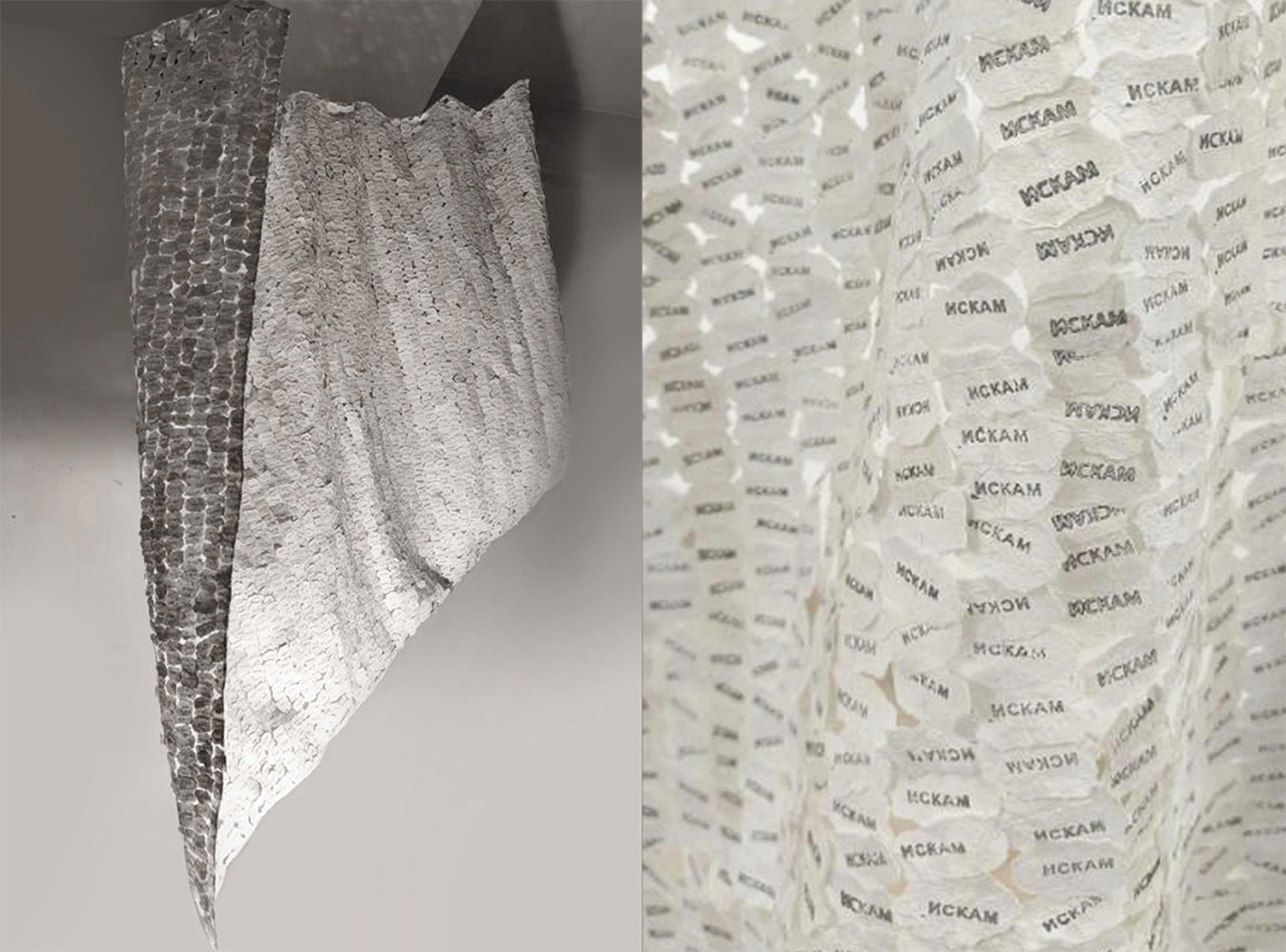
Constructed entirely from paper, it serves as a medium for recording our desires, decrees, commands and pleas, most of which arise from the very nature of the ego. We leave tiny handwritten prayers at sacred sites, hoping that our pleas will be heard. On paper, we write wishes for the health and happiness of others; with paper banknotes, we purchase the things we desire.
Hell — represented by the front of the shroud — is the place we construct for ourselves through our desires: small or great, insignificant or overwhelming, impulsive or deeply cherished. All are stitched together into a single fabric — mutable, fragile and ephemeral — the final object with which our material bodies come into contact.
The reduction of every desire to a single, symbolic unit — the word “I want” — embodies humanity’s material obsession. “I want” is among the most frequently uttered expressions throughout the entire span of human existence. Today, the assertion of our material self has gained an overwhelming dominance, increasingly eclipsing spiritual values.
The immaculate white reverse of the fabric, by contrast, assumes the form of Dante’s Paradise — a liberation from all earthly attachments, the transcendence of endless desires, and the attainment of the absolute: purification and the possibility of resurrection.
The duality of our existence, suspended between the spiritual and the material, raises the question of whether we should reconsider the ego and its desires. Its expression through reciprocity, contentment, empathy and self-awareness might offer a vision of what Paradise could mean in our contemporary world. Perhaps Paradise is where “I want” gives way to “I am.”
— There is a Paradise.
— Do you want to go there?
— I want.
Film reference: Dante (2022), directed by Pupi Avati